
TL;DR
Modern organizations are drowning in metrics while starving for actual discernment. True data analysis is not mechanical reporting; it is a discipline of strategic judgment. By mastering the distinction between reporting and analysis, recognizing project trajectories early, navigating Goodhart's Law, conquering analysis paralysis through timed execution, and communicating with absolute clarity, leaders can preserve irreplaceable human intuition in an increasingly automated world.
Introduction: The Great Illusion of the Digital Oracle
We have successfully mapped the electronic wilderness, yet we wander it lost. Modern organizations find themselves drowning in oceans of cold data while starving for a single drop of genuine insight. Call it the Data Paradox. We have constructed grand, blinking altars of business intelligence dashboards and generative AI tools, yet the path to an authentic, righteous decision has never been more obscured by digital smog.
The structural flaw in our current corporate architecture is the dangerous assumption that owning a tool is identical to possessing wisdom. It is an ancient human error dressed in modern code. A machine can catalog the world, but it cannot comprehend its soul. The value of the modern analyst does not reside in the mechanical manipulation of a spreadsheet or the clever phrasing of an AI prompt. It lives in the quiet, disciplined judgment required to transform raw, chaotic numbers into decision-useful truth. As algorithmic platforms commoditize information, human discernment remains the only durable wall against chaos.
Lesson 1: The Sovereign Line Between Tracking and Understanding
There is a vast gulf between reporting and analysis. Reporting is a passive chronicle of the past; it is the ledger of what has already transpired. Analysis, conversely, is an active descent into the architecture of causality. It asks why an event occurred and illuminates what must be done next.
The clerk records the rain; the prophet discerns the season. The transition from a mere report generator to a true strategic partner requires the ruthless application of two vital questions: "So what?" and "Now what?" If a finding cannot withstand this interrogation, it is not an analysis. It is simply noise masquerading as data.
-
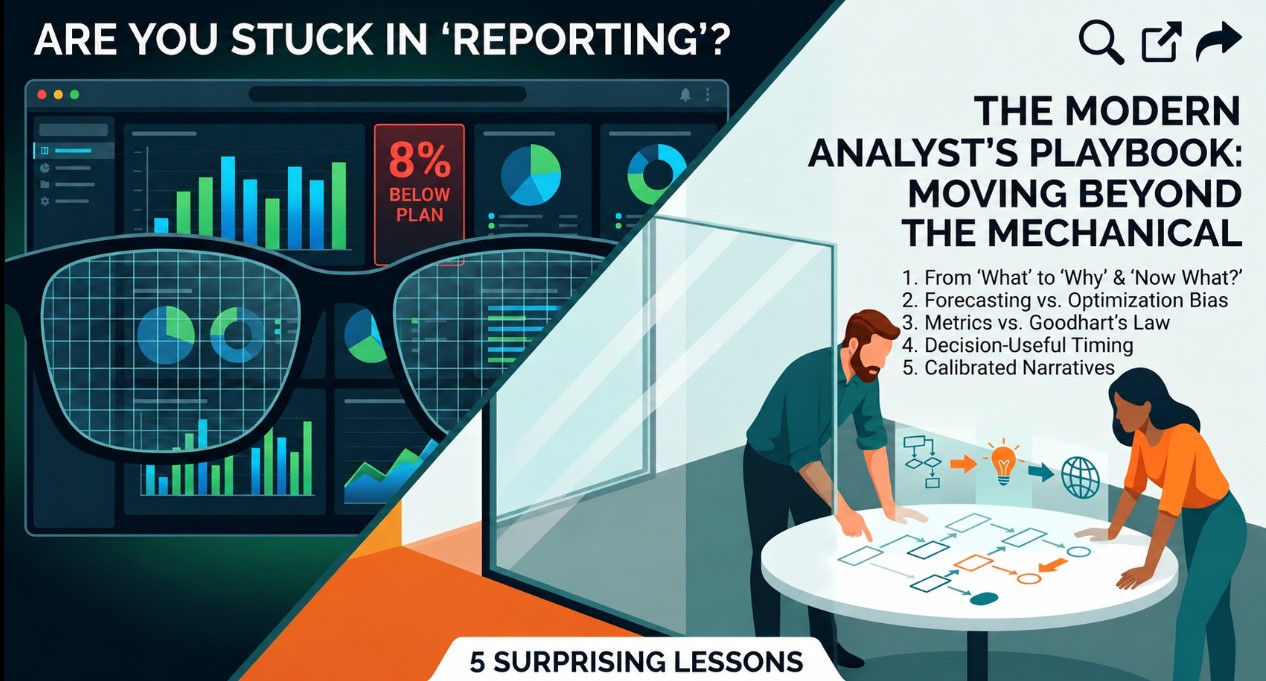
The Sterile Observation: Revenue is below plan by 8 percent.
-
The Strategic Analysis: Revenue is below plan due to a volume shortfall in the enterprise segment, which compromises the full year target unless we immediately alter our go-to-market execution.
By tethering every statistic to context, cause, and a moral obligation to act, the analyst steps out of the corporate compliance theater and into a position of true stewardship.
Lesson 2: The 20% Rule and the Myth of Human Rescue
We treat operational failures as sudden, unpredictable thunderbolts. This is a comforting lie. The future is almost always visible long before we possess the courage to look at it. In the hard disciplines of performance measurement, empirical reality consistently humbles our pride.
A foundational study by Christensen and Heise examined 155 defense contracts across 44 major programs. The findings were mathematically unyielding: once a project reaches a mere 20 percent completion mark, its efficiency ratio stabilizes with startling permanence. The trajectory is set. Performance rarely improves; more often, it degrades under the weight of human denial. Managers routinely fall prey to optimism bias, convinced that they can salvage a sinking vessel through sheer force of will or clever rhetoric.
To counteract this delusion, the modern analyst utilizes reference-class forecasting. This is the outside view. Instead of indulging the fantasy that the current project is entirely unique, the analyst anchors their forecasts to the historical distribution of outcomes from similar endeavors. Realism is a prerequisite for preservation.
Lesson 3: Goodhart’s Law and the Idolatry of the Metric
When a system attempts to turn a measurement into an ultimate target, the measurement itself becomes corrupted. This reality is captured by Goodhart’s Law. In its original 1975 formulation, Charles Goodhart noted that any observed statistical regularity will tend to collapse once pressure is placed upon it for control purposes.
When an organization elevates a metric above the mission, humanity will inevitably game the system to survive. The creation begins to mock the creator through perverse optimization:
-
The Volume Quota: Sales teams close low-value, high-churn accounts simply to cross a numerical threshold.
-
The Resolution Metric: Support personnel close complex trouble tickets unresolved or split single bugs into multiple files to artificially boost their speed ratings.
-
The Output Target: Software developers write bloated, convoluted code to satisfy arbitrary quotas for lines written.
To prevent this decay, strategic leaders must construct balanced metric trees. Quantitative indicators must always be bound to qualitative checks. The number must never be allowed to replace the truth.
Lesson 4: The 40-70 Rule and the Vanity of Total Knowledge
Business moves at the speed of human decision, yet countless organizations paralyze themselves by waiting for perfect clarity. This is a subtle form of arrogance: the belief that if we collect just a few more gigabytes of data, we can achieve omniscience. Omniscience is not a human attribute.
Waiting for total certainty results in beautifully precise post-mortems delivered long after the patient has expired. General Colin Powell provided the definitive antidote with his 40-70 Rule. He posited that a leader should initiate action when they possess between 40 percent and 70 percent of the available information. If you wait until you cross the 70 percent threshold, the window of opportunity has closed, and the initiative belongs to another.
The strategic analyst favors decision-useful timing over exhaustive, belated precision. The task is to provide an honest, calibrated judgment within the hour of crisis, not a flawless autopsy after the opportunity has vanished.
Lesson 5: The Architecture of the Honest Answer
Technical complexity is useless if it is delivered through a veil of confusion. True authority does not drag an audience through the labyrinth of its own labor; it delivers the conclusion clearly and stands by it. Executives do not require a travelogue of your data discovery; they require the destination.
The modern analyst employs an answer-first communication structure based on the classic Minto Pyramid framework:
    [The Answer: Direct Recommendation]
                   |
     [The Question: The Core Problem]
                   |
   [The Complication: What Has Changed]
                   |
      [The Situation: The Context]
Furthermore, an honest narrative demands calibrated probabilities. Vague corporate phrases like "a serious possibility" are dangerous and irresponsible. A historic CIA analysis demonstrated that different individuals interpret that single phrase to mean anywhere from a 20 percent chance to an 80 percent chance of occurrence. The modern analyst replaces ambiguity with clear, responsible estimates. They speak plainly, recognizing that obfuscation is the first refuge of incompetence.
Conclusion: The Human Citadel in an Automated Age
As corporate systems automate the mechanical tasks of data cleaning and pattern recognition, the true calling of the human analyst shifts toward direction and validation. An artificial intelligence lacks institutional memory. It cannot comprehend local traditions, organizational risk tolerance, or the intangible nuances of human character.
This transition is not a distant luxury; it is an immediate necessity. A massive demographic shift is underway as millions of experienced professionals exit the global workforce, carrying decades of unwritten, intuitive judgment with them into retirement. If an organization fails to capture this living wisdom now, its highly publicized, data-driven future will be built upon a foundation of severe collective amnesia.
The ultimate operational question is clear: Is your enterprise actively capturing the logic behind its decisions, or are you merely recording the wreckage after your experts leave the building? The future belongs entirely to those who treat human judgment as an irreplaceable asset.
Comments powered by CComment